Events
May 25, 2026
ICV: Why does it matter to the average consumer?
The UAE’s ICV programme strengthens the economy by keeping more spending inside the country through local sourcing, manufacturing, and investment. This improves supply-chain resilience, supports SMEs, creates jobs, increases household income, and boosts economic growth through the multiplier effect, ensuring more value circulates within the UAE instead of leaving through imports.
ICV: Why does it matter to you?
The UAE’s In-Country Value Programme, commonly known as ICV, is one of the country’s most important economic policies, even though many people outside business and procurement circles may not know much about it.
At its core, ICV measures how much value a company keeps inside the UAE. This can include local manufacturing, local procurement, the use of UAE-based suppliers, and investment inside the country. According to the Ministry of Industry and Advanced Technology, the programme was designed to redirect government procurement and spending by major national companies back into the UAE economy (MoIAT, n.d.).
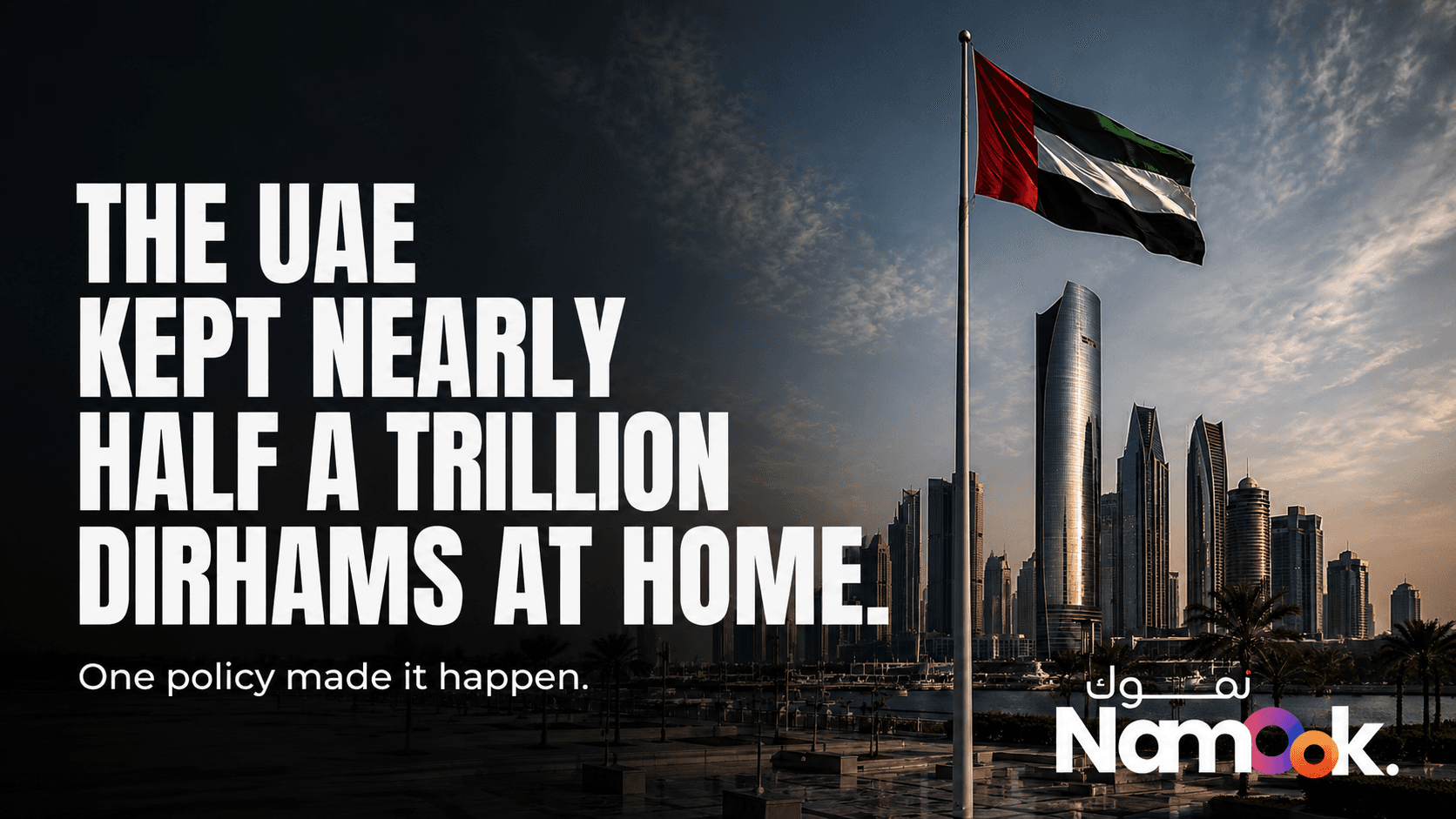
The scale of the programme is significant. By 2026, ICV had redirected more than AED 473 billion into the national economy (WAM, 2026). In simple terms, this means that more money, which might otherwise have left the country through imports or overseas suppliers, is instead being directed toward businesses, workers, manufacturers, and service providers operating inside the UAE.
For companies, the practical value of ICV is also clear. Businesses with stronger ICV scores can become more competitive when bidding for tenders and contracts with participating government entities and national companies (MoIAT, n.d.). This gives companies a reason to source locally, work with UAE-based suppliers, invest in local operations, and build stronger domestic supply chains.
For SMEs, this can create a major opportunity. Larger companies that want to improve their ICV scores often need more local suppliers, service providers, manufacturers, logistics partners, packaging companies, maintenance firms, and technology vendors. This allows smaller UAE-based businesses to position themselves as part of larger procurement networks and national supply chains.
The Geopolitics
The importance of ICV is not limited to helping companies win contracts. At a deeper level, it is connected to the UAE’s long-term economic strategy.
One major reason ICV matters is supply-chain resilience. The UAE Government Portal states that the National ICV Programme aims to localise supply chains and develop new local industries and services (UAE Government Portal, 2024). This is important because countries that rely too heavily on external suppliers can become vulnerable when global disruptions happen.
The past few years have shown how easily supply chains can be affected by pandemics, shipping delays, geopolitical tensions, export restrictions, and sudden price increases. If essential goods are mostly imported, then a disruption outside the country can quickly affect availability and prices inside the country.
This is especially important for products such as food, pharmaceuticals, medical supplies, industrial inputs, and other essential goods. The goal is not for the UAE to stop trading with the world. The UAE will always remain a global trade hub. The goal is to make sure that, where necessary, the country has enough local capacity to reduce overdependence on external supply chains.
In this sense, ICV is not about isolation. It is about resilience.
The Economics
Beyond supply-chain resilience, ICV also has an important economic logic behind it: the multiplier effect.
The multiplier effect explains how one amount of spending can create a larger impact on the economy when that money keeps circulating locally. Let’s study an example to understand this.
If the government or a major national company spends AED 100,000 on a project, that money not only benefits the first company that receives it. The contractor may use part of that money to buy materials from a UAE-based supplier, pay workers, hire logistics providers, use maintenance companies, and work with other local service providers.
Those suppliers and workers then spend their income again. Employees spend on rent, groceries, transport, restaurants, school fees, and daily services. The businesses receiving that spending then pay their own employees, suppliers, landlords, and service providers. So the original AED 100,000 continues to move through the economy, creating income for multiple people and businesses along the way.
This is where ICV becomes important. If a large share of that AED 100,000 is spent on imported materials or overseas suppliers, then part of the money leaves the UAE much earlier. The first transaction may happen locally, but the next layers of economic activity happen outside the country. In economics, this is called a leakage. A Higher dependence on imports can reduce the domestic multiplier effect because money leaves the local economy faster (OpenStax, 2022; CORE Econ, n.d.).
By encouraging companies to source locally, manufacture locally, hire locally, and invest locally, ICV can reduce some of that leakage. More of the money stays inside the UAE for longer, which means each dirham has more chances to become revenue for a local business, income for a local worker, and spending for another local company.
This impact also spreads beyond the first supplier. A local manufacturer that receives more demand may need more packaging, transport, maintenance, warehousing, technology, raw materials, and professional services. That creates opportunities for smaller businesses around it. In this way, ICV can support not only large companies, but also the SMEs that sit around them in the supply chain.
Why does this matter to the average consumer?
For the average consumer, ICV matters because it affects where money, jobs, and opportunities are created.
If billions of dirhams are spent on imports, that money leaves the UAE and creates income somewhere else. But when more of that spending goes to UAE-based companies, it becomes revenue for local businesses, salaries for local workers, and demand for local suppliers.
That is where the impact starts.
More local contracts can mean more hiring.
More hiring can mean more household income.
More household income can mean more spending in restaurants, shops, schools, transport, housing, and daily services.
More consumer spending boosts revenue throughout different local businesses.
The cycle keeps repeating, the economy keeps growing.
In simple terms, ICV matters because when value leaves the country, the multiplied benefit leaves with it.
But when value stays inside the UAE, it has the chance to become someone’s salary, someone’s business growth, and someone’s next opportunity.
Sources
CORE Econ. (n.d.). The multiplier model: Including the government and net exports.
https://books.core-econ.org/the-economy/macroeconomics/03-aggregate-demand-08-government-net-exports.html
Ministry of Industry and Advanced Technology. (n.d.). National In-Country Value Program (ICV).
https://moiat.gov.ae/en/programs/icv
Ministry of Industry and Advanced Technology. (2021). Mohammed bin Rashid launches Operation 300bn to advance UAE industrial sector.
https://moiat.gov.ae/en/media-center/news/2021/05/23/mohammed-bin-rashid-launches-operation-300bn-to-advance-uae-industrial-sector
OpenStax. (2022). The expenditure-output model.
https://openstax.org/books/principles-economics-3e/pages/d-the-expenditure-output-model
The Official Portal of the UAE Government. (2024). The National In-Country Value (ICV) Program.
https://u.ae/en/about-the-uae/strategies-initiatives-and-awards/strategies-plans-and-visions/industry-science-and-technology/the-national-in-country-value-icv-program
WAM. (2026). Largest-ever Make it in the Emirates opens Monday with 120,000 visitors plus first-ever AI showcase.
https://www.wam.ae/en/article/c00z0hn-largest-ever-make-the-emirates-opens-monday-with